Why Do I Sleep Better in a Cold Room? The Science of Core Body Thermoregulation
Why must you physically cool down to fall asleep? Understand the biological physics of thermoregulation, the circadian temperature rhythm, and the ideal bedroom climate for deep rest.
Executive Summary
Why must you physically cool down to fall asleep? Understand the biological physics of thermoregulation, the circadian temperature rhythm, and the ideal bedroom climate for deep rest.
Sleep is not just a neurological phenomenon; it is a profound thermodynamic event.
You cannot aggressively force your brain into unconsciousness if your physical environment directly contradicts your biology. Aside from light exposure, Core Body Temperature is the most critical environmental trigger for initiating—and sustaining—restorative, high-quality sleep.
For your brain to transition effectively from wakefulness into the initial stages of light sleep, your core body temperature must biologically uncouple from its daytime peak and drop by approximately 2 to 3 degrees Fahrenheit (1 to 1.5 degrees Celsius).
If you fail to achieve this temperature drop, your brain fundamentally struggles to initiate the sleep sequence, resulting in hours of frustrated tossing, turning, and sweating.
The Physics of the Circadian Temperature Rhythm
Like the production of melatonin, your core body temperature operates on a strict 24-hour circadian cycle controlled by the Suprachiasmatic Nucleus (SCN) in your brain.
- The Daytime Peak: During the late afternoon (typically between 4:00 PM and 6:00 PM), your core temperature reaches its absolute 24-hour maximum. You are physically warmest, your reaction times are fastest, and cardiovascular efficiency is peaked.
- The Evening Descent: As the sun sets and melatonin begins to synthesize, your biology initiates an active cooling protocol. The brain opens up the blood vessels in your hands, feet, and face (a process called vasodilation). This pumps warm blood away from your central organs and out to your extremities, allowing massive amounts of body heat to radiate out into the surrounding environment.
- The Overnight Trough: By roughly 4:00 AM, you reach your core temperature minimum—the absolute coldest you will be all day. It is during this ultra-cool state that the deepest phases of slow-wave sleep optimally occur.
The Warm Bath Paradox
Most people intuitively understand that a hot bath or shower before bed helps them sleep. However, they completely misunderstand the biological mechanism behind why it works.
You do not sleep better because the hot water makes you feel “warm and cozy.” You sleep better because the hot water forces your blood vessels to massively vasodilate. When you step out of the hot bath and into a cool bedroom, your body rapidly dumps all of that core heat into the air.
You experience a sudden, dramatic plunge in core body temperature, which acts as a powerful, immediate biological neuro-sedative.
Engineering the Ideal Sleep Climate
Because humans wearing pajamas beneath heavy blankets trap incredible amounts of radiating body heat, the ambient temperature of your bedroom must be exceptionally cool to continue pulling thermal energy away from your organs.
If your bedroom is too warm, your body cannot dump the heat. Your core remains elevated, and your brain continuously triggers micro-arousals (waking you up for seconds at a time) throughout the night, completely shattering your sleep architecture and destroying your time in Deep Sleep.
Here is the thermal blueprint for restorative rest:
- The 65°F (18.3°C) Standard: Extensive clinical sleep science suggests the optimal ambient bedroom temperature for the average adult lies between 60°F and 67°F (15.5°C to 19.4°C). Set your thermostat to 65°F an hour before bed.
- Extremity Heating: If your core cannot push blood to your extremities, you cannot dump heat. Counterintuitively, wearing light socks to bed specifically warms the feet, dilating the blood vessels there and allowing the core of your body to cool down faster.
- Breathable Contact Matrices: Ensure that the materials touching your skin overnight do not synthetically trap heat. Opt for highly breathable, phase-change memory foams, natural hyper-breathable fabrics, and structural pillows that actively permit airflow rather than suffocating the neck and head.
Align your bedroom’s thermodynamics with your body’s evolutionary necessity, and watch your sleep efficiency skyrocket.
Deepen Your Rest Architecture.
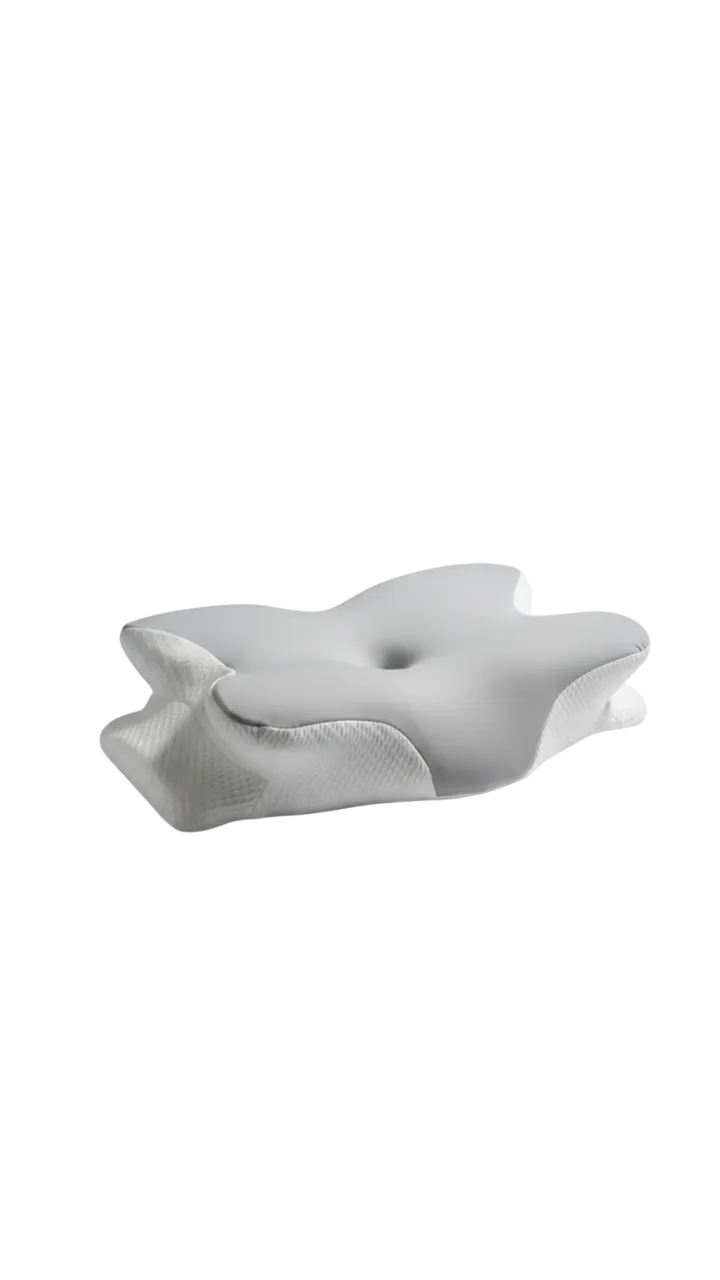
The Lunari Butterfly Pillow naturally supports proper cervical alignment, unlocking deeper, uninterrupted sleep cycles.