Why Do We Yawn When We Are Tired? The Neuroscience of Brain Cooling
Why do we actually yawn when we are tired? Uncover the startling biophysics of yawning, contagious empathic responses, and the necessity of brain-cooling for deep sleep.
Executive Summary
Why do we actually yawn when we are tired? Uncover the startling biophysics of yawning, contagious empathic responses, and the necessity of brain-cooling for deep sleep.
It is one of the most universally recognized biological behaviors on the planet. From human beings and chimpanzees to dogs and even snakes, almost all vertebrates engage in the exact same distinct, involuntary reflex: The Yawn.
We universally associate yawning with exhaustion, boredom, or the imminent need for sleep. But for decades, evolutionary biologists and neuroscientists struggled to definitively answer a surprisingly simple question: Why do we physically execute a massive, jaw-stretching inhale when we are tired?
The traditional theory—that we yawn to pull more oxygen into the blood when our breathing becomes shallow—has been completely debunked by modern clinical science. Giving people higher concentrations of oxygen does not stop them from yawning.
The true purpose of a yawn is not respiratory. It is thermodynamic. Yawning is the body’s autonomous biological radiator system for an overheating brain.
The Physics of Brain Cooling
The human brain is an incredibly energy-dense organ. Despite only making up about 2% of total body weight, it consumes roughly 20% of the body’s entire metabolic energy.
Because neurons are constantly firing, processing sensory data, and executing logic, the brain generates a massive amount of physical heat throughout the day. Like a high-performance computer CPU, if the brain gets too hot, its processing speed degrades. It becomes sluggish, reaction times plummet, and cognitive fatigue sets in.
When you are deeply exhausted, or when you have been awake for over 16 hours, your brain temperature naturally peaks. And crucially, to successfully transition into restorative sleep, your core brain temperature must drop.
This is where the yawn is deployed as a violent, emergency cooling mechanism.
The Mechanics of the Yawn
A yawn is not just a deep breath; it is a highly coordinated musculoskeletal event.
- The Massive Stretch: When you yawn, you forcefully stretch the jaw, the neck muscles, and the facial structure. This violent stretching physically forces massive amounts of warm blood out of the superficial vessels of your head and face, creating a sudden vacuum that draws cooler blood up from the core.
- The Wind-Tunnel Effect: Simultaneously, you execute a massive inhalation of cooler ambient air. This sudden rush of cool air moves rapidly through the nasal and oral cavities, directly interacting with the extensive network of blood vessels immediately surrounding the forebrain.
- The Heat Exchange: Through simple convective cooling, the rush of cold air dramatically pulls thermal energy out of the blood entering the brain.
Within seconds of a yawn, the physical temperature of your brain is measurably reduced. You yawn when you are tired specifically because the brain is desperately attempting to cool its circuitry down to initiate the sleep sequence.
The Mystery of Contagious Yawning
The thermal regulation theory perfectly explains why an individual yawns. But it does not explain the bizarre, highly observable phenomenon of contagious yawning. Why is it that when you see someone across the room yawn—or even simply read the word “yawn”—your brain suddenly forces you to do the exact same thing?
The answer lies deep within the brain’s social and empathic architecture.
Contagious yawning is a phenomenon driven by the Mirror Neuron System—the exact same highly advanced neurological circuitry that allows humans to feel empathy, understand the emotions of others, and execute complex social bonding.
When your mirror neurons detect a yawn in your peripheral vision, they simulate the action internally, frequently triggering the physical reflex in your own body. This is a deeply ingrained evolutionary survival mechanism. In early hominid tribes, collective sleep and collective wakefulness were absolutely vital for defending against predators.
If the sun was setting and the leader of the tribe yawned (signaling the brain-cooling phase prior to sleep), the contagious yawn rippled instantly through the entire tribe. It functioned as an unspoken, involuntary biological command: Synchronize your internal thermostats. It is time for the tribe to sleep.
The Health Indicator
Frequent, excessive yawning in cool environments when you are not actively tired can be a subtle clinical marker for severe underlying sleep fragmentation or dysregulation of the autonomic nervous system.
But a massive, deeply satisfying yawn at 10:30 PM is not just a sign of fatigue. It is your biology brilliantly executing millions of years of evolutionary thermodynamics, preparing the hardware of your mind for absolute rest.
Deepen Your Rest Architecture.
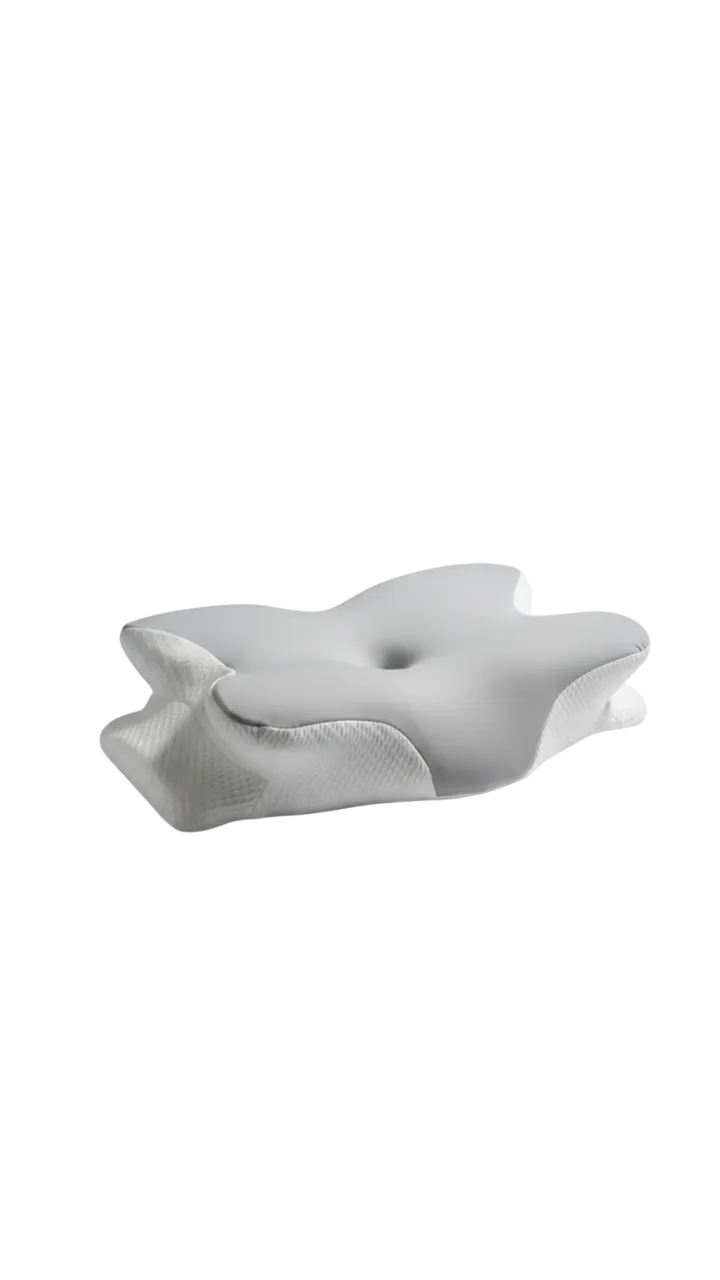
The Lunari Butterfly Pillow naturally supports proper cervical alignment, unlocking deeper, uninterrupted sleep cycles.