Oura Ring vs. Whoop vs. Apple Watch: Which Sleep Tracker is Actually Accurate?
Deconstruct the hardware limitations of photoplethysmography (PPG). Why optical sensors are brilliant at tracking Heart Rate Variability, but struggle with EEG-level sleep architecture staging.
Executive Summary
Deconstruct the hardware limitations of photoplethysmography (PPG). Why optical sensors are brilliant at tracking Heart Rate Variability, but struggle with EEG-level sleep architecture staging.
Five years ago, tracking your sleep required booking a deeply uncomfortable, $2,000 overnight stay in a clinical polysomnography lab, covered in dozens of wired electrodes.
Today, millions of individuals are tracking their nightly recovery using sleek Titanium rings (Oura), hyper-minimalist fabric straps (Whoop), and high-definition smartwatches (Apple Watch).
These devices generate incredibly beautiful, highly gamified morning “Sleep Scores.” They tell you exactly how many minutes you spent in Deep Sleep, when you entered REM, and how “ready” your body is for the day. But behind the beautiful UI interfaces, a massive clinical question remains:
Are these consumer devices actually telling the truth?
1. The Physics of PPG (Photoplethysmography)
To understand accuracy, you must understand the hardware.
None of these consumer devices are actually monitoring your brainwaves. The only way to accurately map sleep architecture is via an EEG (electroencephalogram), which measures electrical frequencies surging across the skull.
Instead of reading your brain, the Oura Ring, Whoop, and Apple Watch rely on a technology called PPG (Photoplethysmography). If you look at the bottom of the sensor, you will see rapidly flashing green or red LEDs. The device shines light through your skin into your capillaries, and measures the light that scatters back to calculate exactly how fast the blood is pulsing.
By calculating the microscopic fluctuations in blood volume and physical movement (using a 3D accelerometer), the device uses complex machine-learning algorithms to guess what your brain is doing.
2. What Trackers Get Mathematically Perfect
If you are evaluating these devices purely on their ability to track the cardiovascular system and the autonomic nervous system, they are world-class instruments.
- Total Sleep Duration: Because they are tracking your absolute heart rate and physical wrist/finger movement, these devices are routinely 90%+ accurate at determining the exact minute you fell asleep and the exact minute you woke up.
- Heart Rate Variability (HRV): This is the ultimate metric for measuring biological stress and physical recovery. The Oura Ring and Whoop Strap are clinically proven to calculate your HRV with near-medical perfection.
- Core Temperature: Devices like the Oura Ring v3 track skin temperature with incredible precision, often predicting a fever or a woman’s menstrual cycle days before the user consciously feels symptoms.
3. The “Sleep Staging” Illusion
This is where the marketing violently collides with the clinical reality.
When your Apple Watch tells you that you received exactly “1 Hour and 12 Minutes of REM Sleep,” it is executing an algorithmic hallucination. Because the device cannot see your brainwaves or track your actual eye movement, it is simply guessing that you are in REM because your heart rate slightly elevated and your arm stopped moving.
Clinical validation studies comparing consumer wearables against Gold Standard laboratory EEGs consistently prove that commercial devices are only 60% to 70% accurate at differentiating between Light Sleep, Deep Sleep, and REM Sleep.
- They frequently confuse lying perfectly still while awake with Light Sleep.
- They frequently confuse heavy REM paralysis with Stage 3 Deep Sleep.
4. The Hardware Showdown
If you must invest in a sleep tracker, the physical form factor matters significantly more than the software.
- The Apple Watch: A phenomenal all-around smartwatch, but structurally flawed for sleep. The wrist is a terrible place to measure optical blood flow because there is massive “movement artifact” (the watch slides around on the arm). Furthermore, the battery anxiety of charging the watch every day ruins the pre-sleep routine.
- The Whoop Strap: The choice of elite athletes. It trades the screen for a minimalist sensor strapped tightly to the bicep or wrist. It is built entirely around cardiovascular strain and HRV, providing arguably the best “Recovery Algorithm” on the market, but requires a harsh monthly subscription fee.
- The Oura Ring: Clinically, the best anatomical choice. The blood vessels on the underside of the finger are massive, highly superficial, and the ring physically cannot slide around during the night. It provides the highest-fidelity thermal and pulse data with zero screen distraction and a 7-day battery life.
The Final Verdict
Do not obsess over the specific “Deep Sleep” minute counts. The algorithm is guessing.
Instead, use these devices strictly as Directional Compasses. If your Oura Ring tells you your HRV dropped by 30% after drinking two glasses of wine, the device is telling you the absolute biological truth. Use the wearables to track your heart, but trust your subjective morning energy to track your brain.
Deepen Your Rest Architecture.
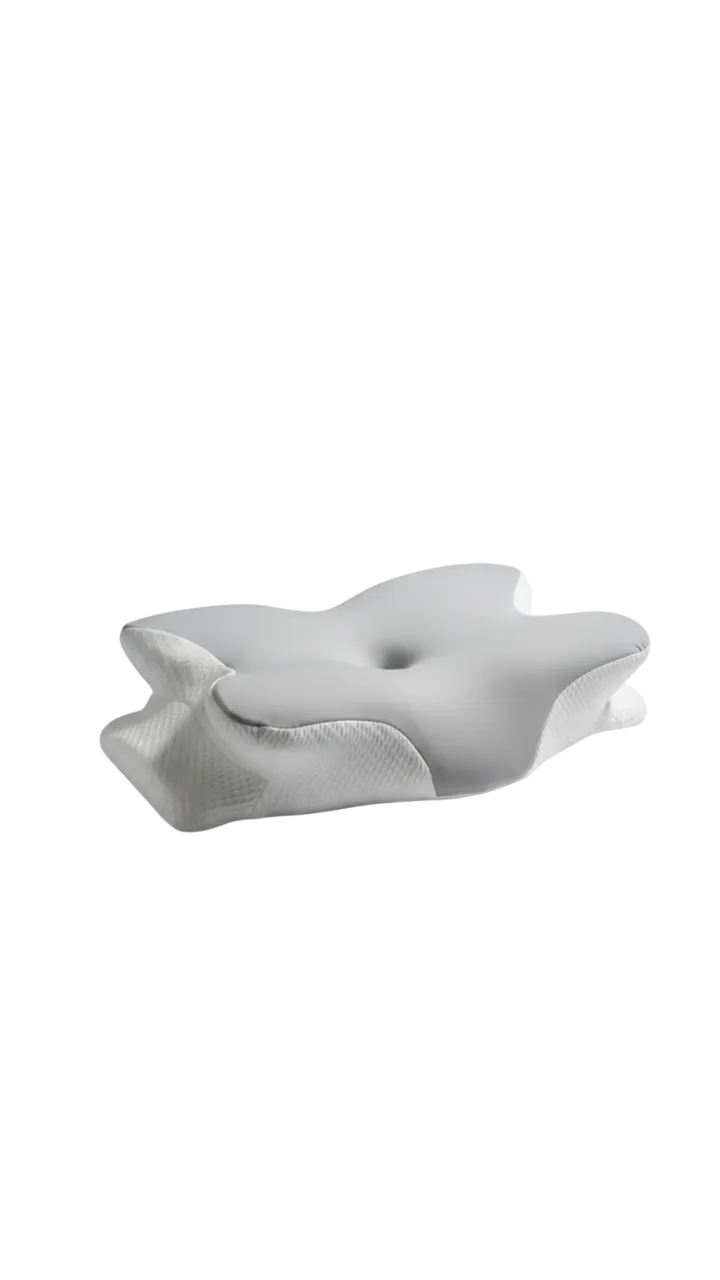
The Lunari Butterfly Pillow naturally supports proper cervical alignment, unlocking deeper, uninterrupted sleep cycles.