Why Does Lack of Sleep Increase Physical Pain? The Somatosensory Cortex
Discover the horrific link between lack of sleep and physical pain. Learn how sleep deprivation destroys your body's natural painkillers and drastically lowers your pain tolerance.
Executive Summary
Discover the horrific link between lack of sleep and physical pain. Learn how sleep deprivation destroys your body's natural painkillers and drastically lowers your pain tolerance.
It is a near-universal human experience: After a night of terrible sleep, you wake up feeling physically fragile. Your joints ache, old injuries flare up, and an incredibly minor bump against a desk corner creates an intense, agonizing burst of pain that would normally just be a slight annoyance.
Most people assume this is simply the body feeling “tired and weak.”
Neuroscience tells a vastly more terrifying and specific story. Sleep deprivation does not just make you feel subjectively weak; it biologically rewires the pain processing centers of your brain, artificially amplifying incoming pain signals while simultaneously destroying your brain’s natural ability to suppress them.
The Neurology of Pain (Nociception)
When you stub your toe or suffer an injury, the physical tissue damage triggers specialized nerve endings called nociceptors. These nerves fire a high-voltage electrical signal up your spinal cord and straight into your brain.
But sensing the signal is only half the equation. The brain has to process it, interpret how severe it is, and then react to it.
This interpretation relies on two distinct neural pathways:
- The Somatosensory Cortex: The region of your brain responsible for sensing exactly where the pain is and rating its raw, objective intensity.
- The Striatum and Insula: The brain’s internal analgesic (pain-killing) system. In a healthy, well-rested brain, these regions actively assess the incoming pain signal and release natural endorphins and dopamine to blunt the agony and soothe the nervous system, effectively “turning down the volume” of the pain.
The Devastation of Sleep Loss
In a groundbreaking clinical study conducted by sleep researchers at UC Berkeley, scientists mapped the brains of healthy adults inside fMRI scanners while applying targeted amounts of painful heat to their legs. They then kept the participants awake for a full 24 hours and applied the exact same amount of heat.
The neurological reaction was catastrophic.
- The Pain Amplification: In the sleep-deprived brains, the somatosensory cortex registered a massive, violent spike in activity. The brain physically interpreted the exact same objective level of heat as being significantly hotter and far more agonizing. The baseline threshold for what the brain considered “painful” plummeted drastically.
- The Loss of the Biological Painkiller: Even worse, the fMRI scans revealed that the natural pain-killing centers—the striatum and the insula—went completely dark. They suffered a near-total shutdown.
When you are sleep-deprived, your brain not only turns up the psychological volume of the pain you are experiencing, but it completely revokes your access to the internal biological pharmacy that typically blunts the agony.
The Chronic Pain Feedback Loop
This neurological reality creates one of the most devastating biological feedback loops in modern medicine.
If you suffer from a chronic pain condition—such as arthritis, a herniated lumbar disc, or severe fibromyalgia—the baseline pain makes it incredibly difficult to fall asleep. The physical discomfort constantly triggers micro-arousals, completely shattering your deep sleep architecture.
Because your sleep was fragmented, you wake up the next morning significantly sleep-deprived. Your somatosensory cortex becomes hyper-sensitized, and your internal pain-killing centers shut down.
Consequently, your baseline arthritis pain feels exponentially worse the following day. This amplified, agonizing pain drives massive spikes of stress and cortisol, making it even harder to sleep the next night, which further escalates the pain tolerance crash the following morning.
Severing the Loop
To escape the pain feedback loop, you must treat sleep not as a biological luxury, but as the single most potent non-opioid painkiller in existence.
You cannot medicate your way out of sleep-deprivation-induced hyperalgesia (heightened sensitivity to pain). You must engineer your environment to explicitly eliminate all possible physical friction at night:
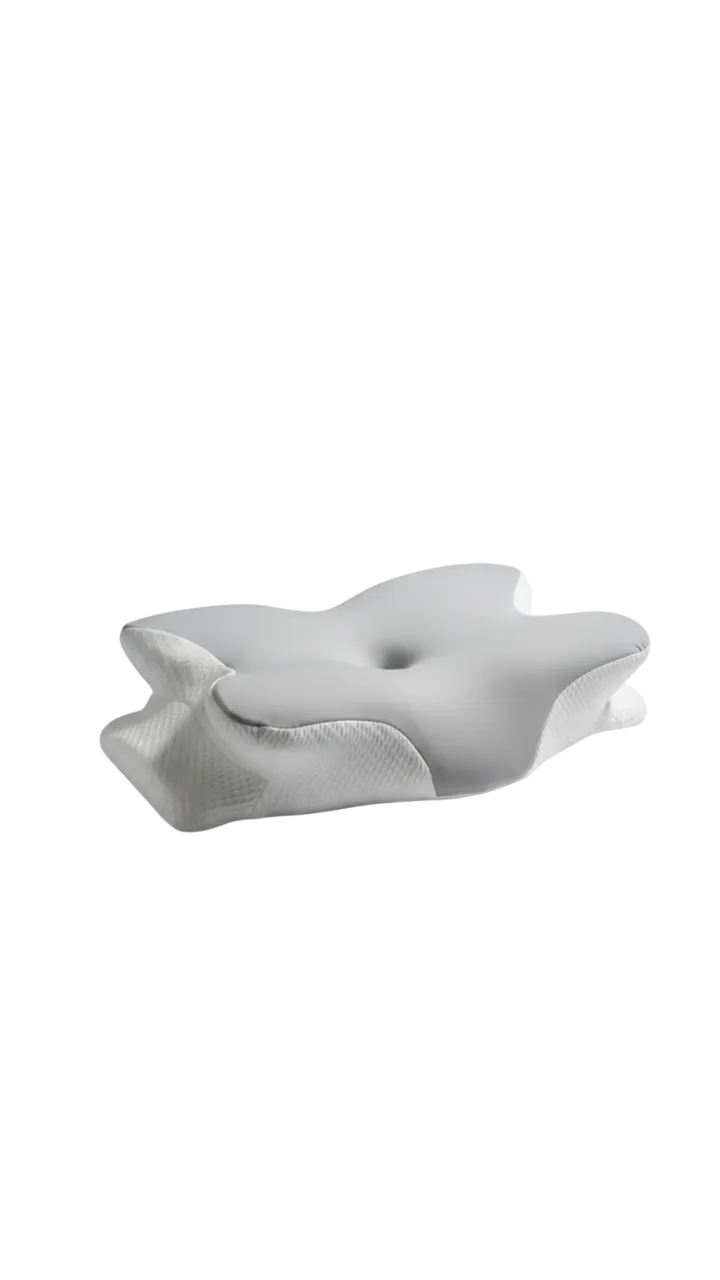
- Precision Alignment: Use highly engineered orthopedic sleep surfaces (like cervical alignment pillows) to ensure your spine remains in absolute absolute zero-gravity neutrality, preventing joint torque from triggering micro-arousals.
- Massive Thermal Dump: Chronic pain is highly inflammatory. Maintaining a deeply cool 65°F (18°C) sleep environment manually suppresses whole-body inflammation overnight, allowing the brain to sink deeply into Stage 3 Delta-wave sleep.
It is uniquely during these towering Delta waves that the brain repairs its internal analgesic circuitry, turning the volume back down on waking reality.
Deepen Your Rest Architecture.
The Lunari Butterfly Pillow naturally supports proper cervical alignment, unlocking deeper, uninterrupted sleep cycles.