Is Snoring Dangerous? Sleep Apnea and Cardiovascular Disease
Discover the terrifying biology behind heavy snoring. Learn how Obstructive Sleep Apnea literally suffocates the brain, triggering massive adrenaline spikes that destroy the human heart.
Executive Summary
Discover the terrifying biology behind heavy snoring. Learn how Obstructive Sleep Apnea literally suffocates the brain, triggering massive adrenaline spikes that destroy the human heart.
In modern society, massive, rattling snoring is often treated as a domestic joke—an annoying habit that forces partners to wear earplugs or sleep on the couch.
But in the emergency room and the clinical cardiology ward, heavy snoring is not a laughing matter. It is recognized as the absolute loudest biological alarm bell the human body can sound.
If you snore heavily, specifically with periods where the noise completely stops followed by a sudden, violent gasp for air, you are not just “breathing loudly.” You are actively, physically suffocating yourself hundreds of times a night.
This condition is called Obstructive Sleep Apnea (OSA), and ignoring it is the fastest, most effective way to guarantee early-onset catastrophic heart failure.
The Architecture of the Collapse
When you are awake, the muscles in your throat, neck, and tongue are naturally tense, explicitly holding your airway rigidly open so you can seamlessly draw oxygen into your lungs.
When you fall asleep—and specifically when you enter the deepest, most heavily paralyzing stages of REM sleep—your skeletal muscles completely lose their tone. The tissue in your throat artificially relaxes.
In a healthy individual, the airway narrows slightly but remains open. However, if an individual carries excess visceral fat around the neck, possesses a narrow jaw structure, or sleeps directly on their back with terrible cervical alignment, the sheer weight of gravity violently collapses the entirely relaxed throat tissue.
The airway is physically sealed shut.
Your diaphragm continues to heave, trying desperately to pull oxygen down into the lungs, but the throat is blocked. The resulting vibration of the collapsing tissue against the struggling air is what generates the loud sound of snoring.
But eventually, the tissue collapses entirely. The snoring completely stops in dead silence. You have stopped breathing. This is an Apnea.
The Neurological Panic
What happens to your biology when you stop breathing for 20 to 60 seconds while unconscious?
- The Suffocation Signal: The oxygen saturation (SpO2) in your blood begins to plummet drastically. A healthy SpO2 is roughly 98%. During a severe apnea, it can drop to 80%, 70%, or even a truly lethal 60%. Your brain is physically starving for oxygen.
- The Adrenaline Dump: The brain realizes you are actively dying. To save your life, it violently smashes the “Fight or Flight” panic button. The sympathetic nervous system blasts your bloodstream with a massive surge of pure adrenaline and cortisol.
- The Micro-Arousal: This chemical explosion forces your brain to execute a violently fast micro-arousal. You briefly snap half-awake, your airway physically wrenches open, you violently gasp for a massive burst of air, and you immediately plunge back toward sleep, completely oblivious to what just happened.
In a severe case of untreated sleep apnea, this horrific suffocation and adrenaline cycle repeats itself 30 to 60 times an hour. You are being chemically electrocuted awake every single minute of the night.
The Destruction of the Human Heart
The cardiovascular consequences of this disease are absolute.
Every single time the adrenaline spikes to wake you up, your blood pressure violently surges. Instead of enjoying the beautiful, deeply healing cardiovascular “dip” that normally occurs uniquely during deep parasympathetic sleep, an apnea patient’s blood pressure is hammered upward all night long.
Over the course of five, ten, or twenty years, this massive, unyielding nightly pressure physically thickens and stiffens the walls of the arteries and the heart muscle. It directly initiates severe chronic hypertension, massively accelerates the calcification of the blood vessels, and radically increases the mathematical probability of a catastrophic midnight stroke or heart attack.
Engineering the Airway
Snoring is not a personality trait. It is a severe structural failure.
Reclaiming your airway requires immediate mechanical and behavioral intervention. Losing heavy visceral fat directly physically unwinds the weight crushing the throat. However, the fastest zero-day intervention is Postural Engineering.
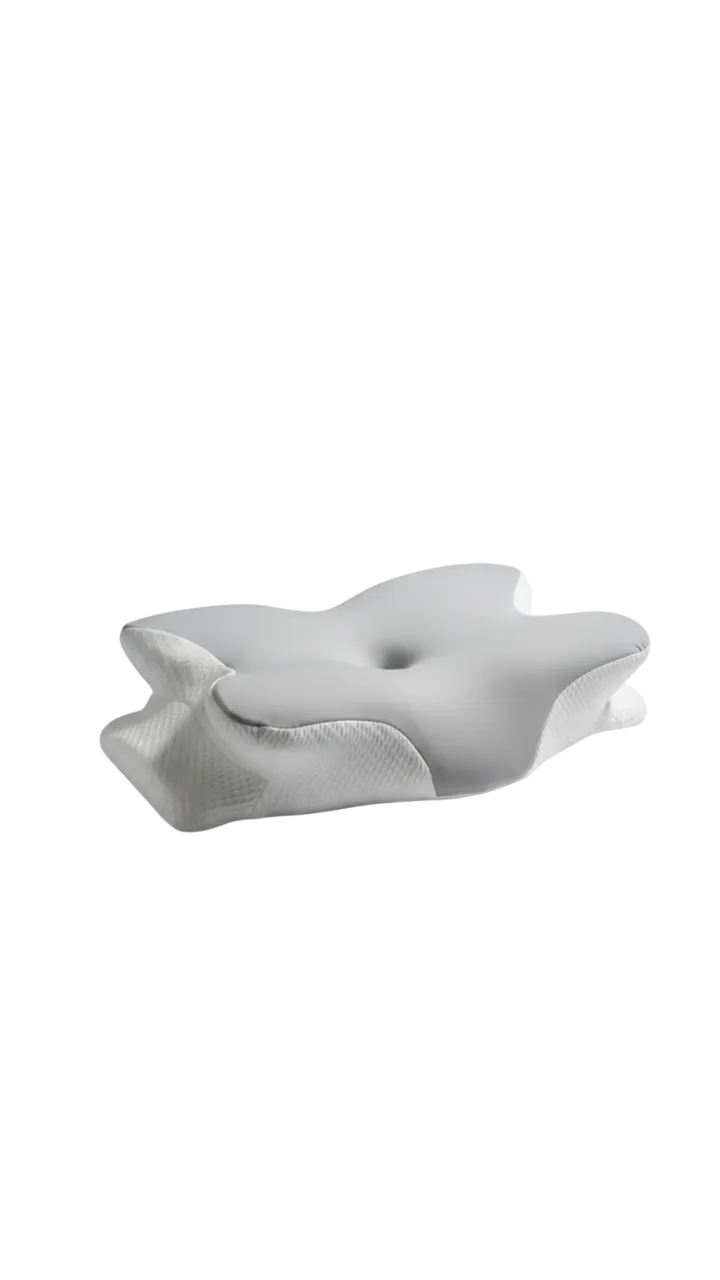
Sleeping directly on your back maximizes the sheer force of gravity acting on the tongue and the airway. Side-sleeping, specifically when heavily supported by a cervical-alignment matrix that keeps the spine and neck perfectly neutral, structurally prevents the jaw from sliding backward. Eliminating the collapse eliminates the suffocation, finally allowing the cardiovascular system the peace it requires so desperately to heal.
Deepen Your Rest Architecture.
The Lunari Butterfly Pillow naturally supports proper cervical alignment, unlocking deeper, uninterrupted sleep cycles.