Is Your Mattress Causing Insomnia? The Physics of Spinal Alignment
The mechanics of the skeleton. Deconstruct the $30 billion mattress industry. Discover why ultra-plush mattresses destroy the lumbar curve, triggering massive cortisol arousals.
Executive Summary
The mechanics of the skeleton. Deconstruct the $30 billion mattress industry. Discover why ultra-plush mattresses destroy the lumbar curve, triggering massive cortisol arousals.
The mattress industry is a 30-billion-dollar marketing behemoth. For decades, it has sold the Western consumer a highly specific, fundamentally flawed psychological narrative: “A good mattress is a mattress that feels like a soft, sinkable, luxurious cloud.”
This narrative is scientifically catastrophic.
When you get into bed and close your eyes, you are entirely relying on human tissue and the physics of gravity to repair your skeletal structure. If the $2,000 mattress beneath you fails the basic laws of architectural physics, your brain will forcibly wake you up in agony exactly 4 hours later.
Softness is a marketing term. The biological requirement is Spinal Alignment.
1. The Physics of the Cloud
When you spend a third of your life unconscious, your skeletal structure enters a state of profound vulnerability.
The human spine is not a straight steel pole. It is an incredibly complex, naturally curved “S” shape. To properly recover during sleep, the spine must remain in absolute, neutral alignment. The muscles surrounding the spine (the erector spinae, the lumbar stabilizers) must completely power off, relax, and heal.
If you purchase an ultra-plush, ultra-soft “cloud” mattress, you initiate a devastating biomechanical disaster.
The heaviest parts of the human body are the hips and the shoulders. When you lie down on a soft mattress, those massive anchor points aggressively sink deep into the foam. Because the hips sink deeper than the lower back, the natural lumbar curve of the spine violently collapses. The spine is no longer a neutral “S”; it resembles a hammock sagging in the middle.
2. The Spasm and the Awakening
If the spine is sagging in the middle, the brain registers an immediate, critical threat.
The brain realizes the spinal cord (the master neurological highway of the body) is currently bent structurally out of position and is at massive risk of permanent injury.
To protect the vertebrae, the brain executes a desperate override. It sends a high-voltage electrical signal to the lower back muscles, commanding them to violently contract and “splint” the spine to force it back into alignment.
You are asleep, totally unconscious, and your lower back muscles are doing a massive, high-tension isometric workout against gravity to save your spine from the mattress.
Exactly three hours later, those muscles fail. They spasm from the unbearable tension. The spasm shoots a massive pain signal directly up the spinal cord, causing a massive release of Cortisol (adrenaline).
Your eyes snap open at 3:00 AM. Your lower back is completely locked up in agonizing pain. You cannot figure out why you “must have slept weird.” You didn’t sleep weird. You slept perfectly the exact way the mattress forced you to.
3. The Concrete Slab Phenomenon (Too Firm)
In response to back pain, many adults radically overcorrect. They assume that if an ultra-soft bed broke their back, an ultra-firm, concrete-hard mattress will fix it.
This creates an entirely different physical crisis.
If you lie on your side on a mattress that is too hard, the mattress does not yield. It aggressively pushes back against your massive bone structures—specifically, the hip joint and the shoulder joint.
All 180 pounds of your body weight is violently concentrated entirely on two tiny pressure points (the hip bone and the shoulder blade).
Within 45 minutes, the intense pressure cuts off the blood circulation to the skin and nerve endings in the hip. The tissue begins to die from oxygen starvation (ischemia). The brain detects the lack of blood flow, sounds the alarm, and forces you to violently toss and turn to the other side to restore circulation.
You spend the entire night constantly flipping back and forth like a rotisserie chicken, executing dozens of micro-arousals, completely destroying your Deep Sleep architecture just to maintain basic blood flow to your joints.
4. Engineering the Neutral Matrix
The biological objective of a mattress is exact structural equilibrium.
The mattress must be firm enough to push back against the lower lumbar curve (preventing the hammock sag), but it must feature exactly 2 to 3 inches of highly responsive, pressure-relieving foam to allow the hip and shoulder bones to slightly sink in, completely eliminating circulation cutoff.
The Alignment Test: When you lie perfectly flat on your mattress, have someone take a photograph of your spine from behind. If you can draw a perfectly straight, horizontal line from the base of your neck directly down to your tailbone, the mattress is structurally sound.
If the line dips, the mattress is a biological failure. Do not sacrifice your lumbar vertebrae for the illusion of a luxury cloud.
Deepen Your Rest Architecture.
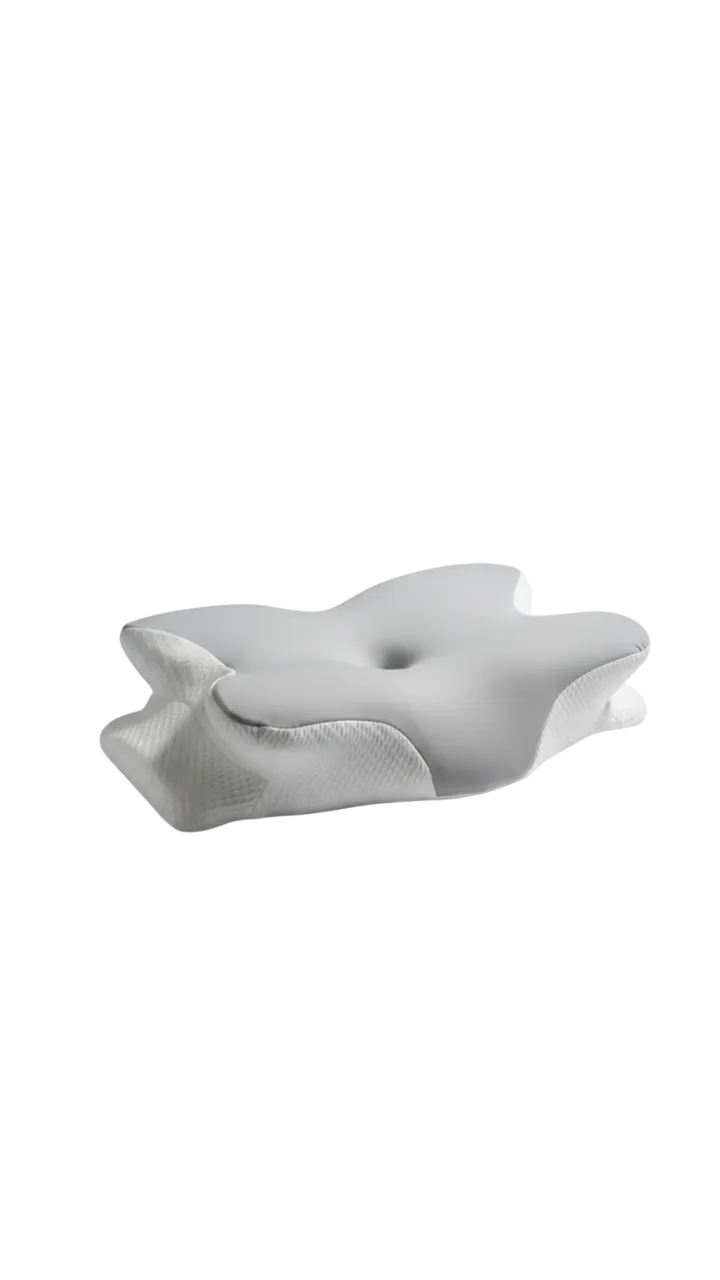
The Lunari Butterfly Pillow naturally supports proper cervical alignment, unlocking deeper, uninterrupted sleep cycles.